Online Journalism Today

Designed by Katie Stout

  • lifestyle
  • sports
  • About
  • Hood College

The Three or Four Credit Dilemma

November 4, 2015 by admin

Evan Reed

There is a task force that has been established by the president of the college, Dr. Chapdelaine, and the board of trustees to study the whole issue of faculty workload. And finally professional service to Hood College and to their students. This group will will meet for the first time on this coming Friday. It consists of two trustees, three faculty members and the provost. They will provide a statement about the issue and a significant amount of data describing what has happened in this curricular area over the last several years.

In 2010 as part of the overall discussion of what kind of work faculty does and how they should be paid or are paid. After spending much of an academic year on this topic. The board put it into a faculty vote; Should they go to a four course four credit system or “because the Board of Trustees felt that this would be one way of reducing instructional costs and providing additional monies to raise faculty salaries.”Explains Dr. Schick.
Should they increase the faculty teaching expectations from six courses in a year to seven. The faculty rejected both of those suggestions in 2011.

Hood College requires 124 semester credits and the task force has to do something to bring alignment with the number of courses or credits required for graduation. Most schools that have a four course four credit system needing 128 or 132 credits to graduate. So part of the issue is how many credits or courses will be required for a degree.
“I’m afraid of not graduating on time because I can’t get the courses I need.” Satori Thomas a sophomore said, when asked are you have trouble registering for next semester?

In the beginning of the spring of 2014 some academic departments began to change some of their courses from three credit courses to four credit courses. Those who changed credit course loads adjust their classes to meet like three credit courses, three 50 minute periods in a week with a fourth 50 minute to an hour in which they do not meet but students work on their own so they get additional study time.

“I have noticed a difference because I was just working out my schedule for next semester and I have courses overlapping due to the time changes and credit changes.” says Chris Woltz a junior., when asked are you have trouble registering for next
semester?

But the programs that have changed the number of credits in their majors or minors or concentrations have no apparent sign the affects on overall undergraduate curricular mix between core requirements, major or minor concentration requirements and free electives.

While you see it is a complex issue that involves student’s education it involves the nature of a faculty members professional activities, teaching scholarship and student advising. It involves the overall curriculum of the institution, involves Hood College’s finances.

It is a complex issue that has financial, intellectual, workload, morale, governance, issues of all types. it is an interesting somewhat tangled web of issues that they have been directed by the board to sort through which will involve differ through conversations and sharing of information and we will tend to fix this.
Clarified by Dr. Schick.

This issue has course credits is part of a bigger picture were it can effect the graduation rates of Hood College.
Hood College’s graduation rates for First-time Full-time Freshmen based on 2009- 2014
-55% Four years
-64% Five years
-66% Six years
This is a big issue that has to be addressed to improve Hood’s graduation rates for future students.

Filed Under: news Tagged With: classes, college classes, college credits, credits, Hood College

Real People With Real Issues have a Conversation about Sex and Consent

November 4, 2015 by admin

Destani Jameson

On Thursday October 10, the Hood College Health Center and the Coordinator of Diversity inclusion cosponsored an uncensored series conversation about sex and consent. The Coblentz game den was the perfect atmosphere for the drop in conversation for “real people with real issues to have a real conversation.”
Although staff members of the Hood College community sponsored this event, it was a conversation for students and led by students. Travis Eichelberger, Assistant Director of Student Engagement and Diversity Initiatives Coordinator, and Dede Trapp, Staff Nurse from the Health Center, facilitated the conversation.
Free pizza, drinks, candy, condoms and sex education gathered about 15 students. The Coblentz game den was set up in a cozy comfortable setting with couches set up in a circle. The group was instructed to write a topic that connected to sex or consent and place it in the bowl. This is how topics were picked for the discussion.
When asked to define sex, Dede said, “generally speaking, the word sex means either a differentiation of gender or an act between two different people. But sex really means a variety of things.” When asked to define consent she said, “Consent is an informed understanding of a situation whereby the person agrees to whatever type of action either written or verbal. The importance of consent is that both individuals have a clear understanding of what that is, the individual’s responsibility and how to communicate effectively with other people.”
Marnica Johnson, Senior at Hood College
“I wanted to talk about tabloid pornography and how it affects a person’s sex life. Some people see porn as the playbook of what you are supposed to do. Even though some may not be comfortable with what is going on in the “playbook.” You run into a problem when one person says oh that looks like fun and they may want to try it, and that partner has no idea where they got this idea from.”
The conversation began with the evolution of porn. How it went from corny scenes set-ups and sex with condoms to the unrealistic graphic hard-core porn of today. Porn used to be fantasy and unrealistic, now porn is more realistic and much directed by what is going on in society.
Could porn possibly make a partner feel insecure? One of the participants said yes, it makes you feel like you have to compete with the screen. The facilitators mentioned how the accessibility of porn today is different because a person can access porn 24 hours a day.
“In my role at the college, I am an advocate for any student of difference. While I am going to work very hard to support all students, I have to look out for cultural differences, whether international students or racial ethnic students. They have a different concept of consent and making sure that they are prepared for the environment here. There is lots of additional baggage when you are already an underrepresented person and you are dealing with a situation like non-consented sex and what society says about you and your people and fighting against those stereotypes,” said Travis.
The next topic of discussion was losing your virginity. The group discussed stigmas of losing your virginity surrounding gender double standards. The environment, community and religious beliefs influence an individual’s decision to lose his or her virginity. The group tackled defining the loss of an individual’s virginity. Some interesting terms extracted from the conversation was oral virgin, and anal virgin. However, the group concluded that the loss of virginity is defined as penis and vagina contact for heterosexual couples.
The value of the virginity increases with age, and the act of having sex is more significant during and post college years. During the pre-college years typically a female who loses their virginity is seen as promiscuous more likely to catch an STD and higher rates of pregnancy. The benefit of a female who loses her virginity pre college avoids the awkward sensation during her college years and is prepared for the emotional attachments that come with sex.
When asked if alcohol is a factor in a scenario do you believe sex is able to be consented?
Jordyn Curtis, freshman at Hood College replied, “No, because no one is in their right state of mind, so you would not know if they were actually okay with it or know their intentions. Drunken heart sober mind, you still never know if that person was fully okay with doing it. “
The facilitators provided a lot of free condoms and sex education pamphlets. They asked students to take them. The facilitators also encouraged students to speak up if any situation arises with an act of non-consented sex. Overall, this uncensored series was a success, looking forward to the next one in November talking about Racial Injustice.

Filed Under: lifestyle Tagged With: consent, diversity, health, Hood College, sex

Ash Beckham Gives Talk on the need for Acceptance of LGBTQ community

November 4, 2015 by admin

Shannon Jones

Students, staff, and faculty gathered to see Tedx speaker Ash Beckham present her talk “Give Voice to Your Truth” on Wednesday, Oct. 27 in the Brodbeck Music Hall.
In this talk, Beckham, who considered herself an “accidental advocate” for the LGBTQ community, addressed the importance of empathy and acceptance and shared her own experiences to engage the audience. The main idea of this talk was “creating a more empathetic community on campus,” she said, and bringing that empathy into other communities as well.
“The first step is to embrace the diversity that we all bring,” Beckham said. “To embrace our own differences, and be willing to share our own stories so people better understand us.”

ab1

(Ash Beckham, photo by Shannon Jones)

Beckham went through and talked about the importance of each word in the title of her speech, “Give Voice To Your Truth,” and what they mean. She started with the word “Truth,” which, to her, is simply “the fire inside us.” She also discussed the words “tolerance” and “acceptance” and how they differ from each other.
“Tolerating isn’t enough. We need to get to the point of acceptance,” Beckham said. “The difference is tremendous.”
Beckham also discussed how to deal with people who do not show acceptance or do not understand. “We have to acknowledge the fact that the words we choose affect other people,” she said after sharing stories of how she lost her temper with people who were rude towards her.
“I eventually realized I wanted to be a passionate cause for change,” Beckham said. “I wanted to maintain my veracity, but also have some serenity and some kindness, and not lose who I was generally as a person to the anger these situations were bringing me.”
The event drew a substantial crowd consisting of students, faculty, and staff. One student, Joe Denicola, thought that Beckham’s speech was thought-provoking.
“I thought [Beckham’s talk] was really interesting,” said Denicola, a senior at Hood College. “I really didn’t think much about the way that you give your own voice, especially not in the way she talked about where you try to find a balance.”
“It doesn’t always have to be confrontational,” he continued. “I never really thought of it that way, mostly because I’m used to more harsher settings, where it’s kind of like, “You’ve got to know this thing or else you’re a horrible person,” and the fact that it kind of steered away from that was really cool for me.”
Beckham first went viral in 2013 with her TEDx talk “Coming Out of Your Closet,” which currently has more than 5 million views on YouTube and covers the subjects of homophobia in society. She has since given other TEDx talks on the topics of sexuality and empathy.

Filed Under: news Tagged With: Acceptance, ash beckham, diversity, Hood College, LGBTQ, ted talks, tedx

Career Center Steers Students towards the right Career Path

November 4, 2015 by admin

Gabrielle Cavalier

Hundreds of students entering their first year of college have absolutely no idea what they want to do as a career path. Some think they do, but then change it three years in. What if there was a place a student could go to for career path advice, right on campus? Well, that’s where the Hood College Career Center comes in.

The Career Center, which can be found on the second floor of the Apple building connected to Whitaker, is the place to go to when a student needs an internship, resume critiquing, career help, volunteering opportunities, etc. The Career Center has plenty of options for students to engage in networking and finding a job after college that is suitable for them.

Lana Veres, the Manager of Experiential Learning Programs, connects students to internship opportunities and even holds mock interviews. She believes that gaining career experience through an internship is ideal if the student wants real world skills that apply to their major. Veres highly recommends students to acquire an internship during college because “they look good on your resume, you can gain experience in your field, and most importantly help you figure out if you want to continue with that field or not.” She also suggests that students partake in not just one, but two internships “just to make sure that that’s the direction you want to head after college.”

Alissa Hart, the Career Development Program Manager, helps students make a perfect resume and also organizes volunteer opportunities, such as the Civic Engagement week during fall break where students volunteers all over Frederick County. “My goal is to get [students] to be self-reflective about what they’ve done in perhaps gaps that they physically see on their resume,” Hart says. “I think students often discount the importance of a resume. My number one advice is that students should put their best foot forward representing themselves as well as they can on that piece of paper.”

Jill Hermes, the Director of the Career Center, focuses on every program of the career center and guides students to the path of graduate school. She advocates coming to the office for resume help, internship opportunities, and volunteering work. Hermes piece of advice is to network yourself, she says to “attend as many networking events as possible” and adds, “getting to know people and articulating your message, your elevator speech, is what will help you meet future employers.”

The Career Center is a huge help if a student is looking to put their foot in the door after graduation. The ladies at the Career Center are always happy to help students in whatever career path they want to take and only want the best for Hood College students.

Filed Under: Uncategorized Tagged With: career path, careers, education, Hood College, jobs, volunteering

Animals Give Emotional Support To Hood Students

November 4, 2015 by admin

bj

(BJ Daisey, photos by Trovato)

Ashley Trovato

An Emotional Support Animal is, according to the writers at anxiety.org, and The National Animal Registry, “an animal that, by its very presence, mitigates the emotional or psychological symptoms associated with a handler’s condition or disorder.”

At Hood College, students are allowed to have a hermit crab or goldfish. They are also permitted other animals, but have to go through the CAAR Center first.

Megan Poole, a senior at Hood College, recounts her experience in obtaining permission to bring a service animal on campus. “It was awful.” Megan said, “The process should not have been as hard as it was.”

Poole is diagnosed with PTSD, severe clinical depression/anxiety, and ADHD. She was permitted to have an animal last year, which was a guinea pig named Angel, and it took over a month to obtain permission. Since she stopped seeing a psychiatrist, residence life and CAAR took that privilege away.

“Psychiatrists are expensive and hard to keep seeing,” Poole said, “I had to stop seeing mine which resulted in me loosing permission for my piggy.”

“Not having Angel around after I come back from work or class makes me feel worried because I am alone and have nothing to help me with my stress,” Poole said. “Having her [Angel] last year made stress easier to handle because when I was upset, I would want to cry so I would cuddle her for hours and feel better.”

Poole explains how having something around has helped in her life. “I still have Angel at home and she has literally been the difference between life and death for me,” Poole said. “Without her at school with me, I feel lost.”

A student who graduated Hood College, Chelsea Laurens, agrees with Poole. “I have three Yorkies, and they 100 percent help me,” Laurens said, “When I was at school and couldn’t have a dog for a couple years I felt like ‘I was missing something’,” she continued by describing how having “something love you unconditionally, no matter what, is a feeling that is indescribable.”

(Alec Van Bronkhorsrt)

(Alec Van Bronkhorsrt)

A therapist not affiliated to the school, but helps with college-aged students, has provided approval for some of her clients to have an ESA. “I am always looking to find new ways to help my patients with mental health diagnosis,” Whitney Thompson, LCPC (Licensed Clinical Professional Counselor), of The Counseling Renaissance in Sykesville, Md, said. “Medication can be helpful, but a pet who shows unconditional love can help to decrease symptoms. Sometimes, clients need something more than just learning coping skills.” Thompson brings her dog, Bodhi, to work. He is a certified therapy pet.

Anthony Belnomi, a Hood alum, said that animals are there to listen. He believes animals act on a level farther than cuddling, “As humans we crave company and companionship. Sometimes connections are stronger without words. With animals, there are no words, just sounds,” Belnomi continues, “Animals calm my mind and restores my faith in the world because animals are genuine in both intent and action.”

A junior, Bj Daisey said, “If I had a dog jump into my arms, especially after a long day, I would embrace it and say ‘of course we can cuddle.’” Daisey said having a dog around would be like having his “own personal study buddy who can listen to me.”

A freshman this year, Alec Van Bronkhorst said, “I miss my dog more than I miss my parents.” He did say that having a pet here to take care of would add unnecessary stress because it is just one more thing to take care of.  Although Bronkhorst added, that when he is playing with the Meyran hall pet, Franklin the dog, his stress levels do lower and he becomes happier.

Poole and Daisey believe that having the privilege, within reason, to have an animal other than a hermit crab or goldfish would be beneficial. “They should have allergy-free dorms for students who have certain pet allergies so that students who would benefit from pets could bring theirs to school with them,’ Poole said.


(Chelsea Laurens)

(Chelsea Laurens)

Every year at finals in the second semester, the campus activities board and counseling center creates an event called “Stress Busters” and brings in a group called Wags for Hope to utilize the power of spending time with animals for mental health. The counselors know how much power having an animal to love has and they want to accommodate those who would benefit. Wags for Hope brings dogs and cats for a few hours so the students can spend time with them and hopefully feel a bit better. Some find stress relief in drinking or other recreational activities, but one way that seems to help is animal interaction.

Filed Under: lifestyle Tagged With: emotional support animals, Hood, Hood College, support animals, therapy

What Science can tell us about the Meaning of Life

November 4, 2015 by admin

Breann Harwood

The meaning of life is something that almost anyone, but especially college students, tends to struggle with. Between making major life choices, deciding on a major and where they will go after graduation, college students face many pressing questions about what to do with their lives.
Around 100 students, faculty, and community members joined Hood College on Tuesday, Oct. 20, as they welcomed social psychologist Laura King. King’s lecture was about “what science can tell us about the meaning of life.” This lecture was in conjunction with the inauguration festivities of Hood’s new president, President Andrea Chapdelaine.
King started out her lecture by paying honor to Chapdelaine, who coincidentally majored in social psychology, and told the audience that they were lucky to have a social psychologist as a president because she can change the campus and the world. She then explored how happiness is equivalent to the experience of meaning, which means, happy people naturally rate higher when rating their meaning of life. However, she emphasized how she was not a positive psychologist, and in fact, found many things skewed with that philosophy. According to positivepsychology.org, positive psychology is the study of “the strengths that enable individuals and communities to thrive.”
King explained that there are many people who have “pretty good lives” and it’s these “pretty good lives” that are full of meaning.
“We see the good life all the time,” King said. “We just need to notice it.”
Scientifically, King asserts, noticing may be even more important than inventing. Certainly, she explains that there is value to both, but a person wouldn’t need an invention if they noticed something new about something that already existed.
The meaning of life, to King, is a paradox.
“The meaning of life happens even if we don’t want it to. There are signs everywhere and we can’t just turn the meaning on or off,” King said.
She then shared with the audience one of her studies about parents who have children with Down syndrome. She asked a variety of these people about their experiences and their rate of how meaningful their life is. Almost all of them rated around 5 out of 7, which is significantly higher than the average “meaningful life” at 3.8.
Other populations that hold a higher meaning of life include those who live in poorer nations. King said that this is overwhelmingly due to the fact they have a stronger religious foundation.
King assured the audience that every one of them already had a meaningful life because they all had the integral parts to what is “meaningful.” Every single person already lives in a world that makes sense and that thrives off of habit and routine; the cornerstone to homeostasis.
King said that one of the strongest correlations in rating a positive meaning in life is helping others. Helping people and volunteering creates a direct connection to a higher rate of meaning, so much so that King suggests there may not truly be such a thing as altruism.
She then concluded her lecture by asking the audience, “What are you going to do with your one extraordinarily meaningful life?”
Senior Aleyna Fitz, a psychology major and current Hood student attended the event for extra credit in one of her classes. She ended up feeling inspired and a little more meaningful after the lecture.

“The biggest thing that I took away from Dr. King’s lecture is that everyone has meaning in their life, even though it’s sometimes hard to see, and that the biggest problem isn’t that we think our lives have too much meaning, but that our lives have no meaning,” Fitz said.
Junior Naila Stocks attended the event because it caught her attention and sounded like something she might enjoy.
“I like how she said that everyone’s life has meaning and that is one of us wasn’t here, right now, we would notice,” Stocks said. “We all matter; we all are the meaning of life.”

Filed Under: lead, news Tagged With: happiness, Hood College, laura king, lecture, meaning of life, psychologist

Students Sniffles begin as Cold Season Rolls Around

November 4, 2015 by admin


Kaylene Wright

Students are beginning to feel it in the air. The sniffles during class, the embarrassing and constant coughs, and that saying among friends, “don’t get to close to me, I’m sick.”
Cold season has begun. The months September through April generally have the more illness than other months. This is because people stay indoors due to the lowering temperatures outside. Cold weather itself does not cause illness, but people congregating indoors causes easy spread of germs from person to person.
Campuses are among the germiest places. Students live in just about as close quarters as you can get. Students share bathrooms and dining halls, and their own room with their roommate or roommates.
“The most common illness that we see in Hood’s Health Center are eye, ear, nose, and throat complaints,” Teresa Cevallos, director of health services at the Hood College Health Center, said. “The reason that they are grouped together is that it is not unusual for a student to have a sore throat along with an earache or nasal congestion.”
Cevallos says that the common cold, officially referred to as an upper respiratory infection, is also a huge complaint. “There is nearly a tie for second place,” she said, “which is gynecological visits and upper respiratory infections.”
Will Shackley, a senior at Hood, is one of the many students who have already been sick this semester. “I had a runny nose, fever, and a sore throat,” he said. “It felt like slight death.”
Meaghan Jones, another student, has also experienced sickness this school year. “It was bad. I had a fever, a runny nose, and felt extremely weak,” she said.
Most students try their hardest to get to class. Sometimes, however, illnesses prevent even normal daily function from occurring. “It was a real struggle just sitting up in bed,” Jones said. “I couldn’t make it to class even if I wanted to.”
Other times, students may be able to make class, but risk infecting other students. “Yes, I was contagious,” Shackley said. “I infected all of my friends who hadn’t been sick already. I don’t know who I got it from.”
Posing a rarer but much more serious threat is the flu. The Center for Disease Control and Prevention reports that flu seasons are unpredictable. Though flu seasons happen every year, they vary in severity and length.
The easiest way to protect against the flu is to get the yearly vaccine. Hood’s Health Center has plenty of flu shots available for students. “We have given 26 flu vaccines to students so far,” Cevallos said. “The majority of our flu shots are given to faculty and staff, but we still have flu vaccine available and would like more students to get them if they don’t get the flu vaccine from their home health care provider or from a local facility.”
“This year’s flu shot was virtually painless,” Alyssa Jenkens, a student, said. “The nurse said there would be a tiny pinch, but I didn’t even realize she had done it.”
Getting a vaccine is extremely quick and doesn’t involve much pain at all. Cevallos says that students may walk in whenever it’s convenient for the student to get the vaccine, and that no appointment is required. “Please tell your friends to come in and get a flu shot!”
Regardless of the sickness, symptoms, or reason for feeling not 100%, basic safety measures can be taken to prevent spreading illness. The single most important way is to frequently wash hands. This is especially important on campus, because as already discussed, many everyday items are shared.
Other basic safety measures students can take include not sharing food or drink with others, covering coughs and sneezes, and maintaining proper sleep and eating habits.

Filed Under: Uncategorized Tagged With: Colds, flu, Germs, Hood College, illness, sickness, vaccines

Academic Balancing Act of Athletes

November 4, 2015 by admin

James A. Brown

Colleges want their students to be well rounded. In addition to academics, schools like their students to be engaged in extracurricular activities, such as community service, playing an instrument, or playing sports. Students who choose to participate in collegiate athletics face different challenges than narps (non-athletic regular people).
Athletics forces students to use their time wisely. Between practice and travel it is not uncommon for student athletes to fall behind. Freshman athletes often struggle the most because they have not been through a collegiate athletic season. They aren’t aware of the time commitment that comes with being a student athlete.
There are a number of ways for freshman athletes to ensure they do not fall behind. All freshman are required to attend at least 4 hours of study hall a week. Freshman athletes who don’t achieve a cumulative 2.3 GPA must continue going to study hall until they have met the requirements. Students believe that study hall helps give them a way to stay organized.
Madison Krauss said, “study hall has helped and I plan out when all my papers and tests are due on my calendar. I plan my work around my sport schedule”. Properly planning when you will do assignments is an essential aspect of being a student athlete.
Playing in the Middle Atlantic Conference, Hood and Stevenson are the only two teams in the conference in Maryland. Hood athletic teams regularly travel 2 hours to compete against teams in Pennsylvania such as Albright, Alvernia, and Lycoming to name a few. Game days are days that students typically plan their work around. After a game, athletes are exhausted and have little energy and motivation to get work done.

Students are responsible for asking for assistance in any courses they aren’t doing well in. Coaches want their players to do well and remain eligible to compete. Coaches are constantly inquiring about how their players are doing. Jayden Barrick, a member of the field hockey team explained that, “you have to set up personal meetings with your coach to check on your grades. They set up a tutor for you if your grades are in danger.” However, it may be difficult for an athlete to make time for a tutor because of their tight schedule. If a tutor is necessary, coaches may let the athlete miss a little bit of practice time to allow them to get the help they need.
It may be difficult for some freshman athletes to learn how to balance academics and athletics. There are numerous places that students can turn if they are having difficulties in the classroom. With the resources available, responsible student athletes will remain eligible throughout the athletic career at Hood.

Filed Under: sports Tagged With: academics, athletics, freshmen, Hood College, Sports

Hood College Hosts “Blockbuster Movie Showcase” series

November 4, 2015 by admin

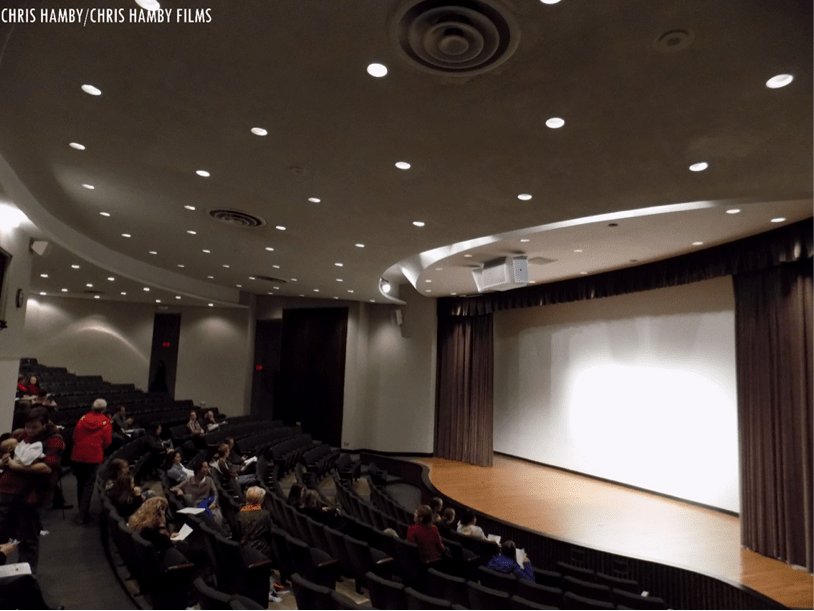
(Hodson Auditorium, photos by Hamby)

(Hodson Auditorium, photos by Hamby)

Chris Hamby

The flickering image on the silver screen. Being immersed in breathtaking surround sound. “Let’s all go to the lobby to get ourselves a treat.”
Nothing beats going to the movies and watching the latest feature films on the big screen.
At Hood College, students and faculty will take a break from the ongoing chaos of schoolwork to attend the college’s “Blockbuster Movie Showcase” series; which will mark its eighth year on campus.
Every semester, members of the Campus Activities Board screen a monthly series of popular second-run major feature films, along with select cult favorites.
Films are screened at Hodson Auditorium, located inside Rosenstock Hall on campus. Select movies are also projected on an inflatable, oversized screen at the softball field during the spring and fall seasons.
Recent screenings have included the fourth film in the Jurassic Park franchise, “Jurassic World,” the 1993 Disney comedy “Hocus Pocus,” and the 1975 cult favorite, “The Rocky Horror Picture Show,” to mark the 40th anniversary of the film. These movies have been popular with most Hood students.
“I definitely liked ‘Hocus Pocus,’ but I didn’t get to see ‘Rocky Horror’,” said Alex Elliott, a freshman student majoring in economics at Hood.
Axelle Blaise, a sophomore student majoring in psychology at Hood, enjoyed the goody bags that were passed out during the screening of “Rocky Horror.”
“It’s cute,” Blaise said.
Christiana Morris, a sophomore student majoring in secondary education at Hood, only attends if the film holds high entertainment value.
“It depends on the movie,” Morris said. “I haven’t been to any of them this semester.”
Gretchen Nonemaker, director of student engagement at Hood College, is one of the people responsible for the campus movie series. She explained how the campus acquired the nontheatrical rights to screen popular motion pictures for the monthly series on campus from two different distributors.

(Interior of the projection booth, inside Hodson Auditorium, located at Rosenstock Hall at Hood College.)

(Projector used for outdoor “Blockbuster Movie” screening at the Hood softball field.)

Swank Motion Pictures is one of the nation’s oldest family-owned nontheatrical motion picture distribution companies. The firm represents the nontheatrical accounts for major studios, including The Walt Disney Co., Lionsgate, Sony Pictures Entertainment, Warner Bros. and affiliated companies.
Criterion Pictures U.S.A., a competitor to Swan, represents the accounts of Paramount Pictures, Twentieth Century Fox and affiliated subsidiaries. This company is not related to “The Criterion Collection,” a high-profile home entertainment label.
“We license movies from both distributors,” Nonemaker said.
She said that the cost of licensing films from Swank and Criterion are determined by the title of the film from the distributors, including the length of the movie rental.
The average cost for a typical nontheatrical film release from Swank or Criterion range from $600 to $1,200. The costs are paid by the campus organizations directly involved in supporting films that are shown on campus.
Today, going to the movies at the first-run cinema can be expensive. The college’s “blockbuster” movie screenings are entirely free to all attendees.

Travis Eichelberger, Hood assistant director of student engagement, filling up one of the popcorn machines before the screening of "The Rocky Horror Picture Show" inside Hodson Auditorium)

Travis Eichelberger, Hood assistant director of student engagement, filling up one of the popcorn machines before the screening of “The Rocky Horror Picture Show” inside Hodson Auditorium)

According to the Los Angeles Times, the motion picture industry discontinued sending physical film prints to theaters in recent years. Films are now delivered via an encrypted file on hard drive-based storage, or via satellite. Nontheatrical features are delivered to Hood for screening on a specialized DVD-Video disc.
The discs that arrive from Swank and Criterion are not ordinary DVD discs; the projectionist in charge has to access a specialized PIN code provided by the distributor, in order for the disc to play.
Along with the cost of licensing films from Swank and Criterion, the sponsoring organizations have also paid for the cost of snacks, soft drinks and goody bags served at the campus movie screenings.
Nonemaker said that the organization is open to other suggested films from campus groups, including classic and independent features.
Katherine Orloff, an assistant professor of journalism at Hood, said that students should not miss out on seeing free screenings of movies on campus.
“I think it’s a great thing for everybody to watch movies on a big screen,” Orloff said.
Donna Bertazzoni, professor of journalism at Hood, said that the movie series is a great way for students to relax from the daily grind.
“At the end of a long week, it’s a great opportunity to relax,” Bertazzoni said.

Filed Under: lead, Uncategorized Tagged With: Blockbuster movies, films, Hood College, movies, screenings

International Students face Struggles Applying to Hood

November 4, 2015 by admin

(Orientation Brochure)

(Orientation Brochure, all photos by Bonnie Monnier)

Bonnie Monnier

Hood College is the home away from home for many students, even those who are 4,625 miles away from their home.
Students from Croatia, China, United Kingdom, Africa and various other countries have been able to experience American education here at Hood. The problem for most international students is not adapting to a new home, it’s arriving to Hood and adapting to the visa restrictions that come upon arrival.
When applying as an international student there is a long process to go through in order to come to the United States. Other than filling out the international student application, they also have to apply for a F-1 student visa and figure out their financial status.
Brittany Salamanca is an alumnae of Hood who was originally from the United Kingdom, found that there wasn’t a lot of issues with applying to Hood but there were difficulties in applying for a visa.

(Strawn Cottage)

(Strawn Cottage)

“I found that it was fairly easy to apply to Hood, it was my visa that was difficult to get,” Salamanca said.
The F-1 visa is for international students that restrict them from living off campus and working. In order to work students must apply for a new visa, which can be difficult, Kathleen Emory, freshman international student coordinator, said.
International students are regulated and monitored which can restrict their experience here at Hood, Emory said. Each form of visa carries its own set of restrictions; regulated mainly by immigration authority but also with the help of Hood staff.
Salamanca had a long waiting period and had to file a lot forms in order to apply for a F-1 visa. Salamanca initially didn’t realize the amount of restrictions that came with a visa.
Salamanca loved her experience at Hood, but struggled with the visa restrictions. “I wanted to do much more, like working, but the application process for a new visa or extension on my visa was so difficult,” Salamanca said.
Emory said that Hood primarily cares about students’ academic records, but also must look at their financial eligibility. “Academically we will accept all students, the major difference between an international student and a domestic student is do they qualify for federal financial aid,” Emory said.
According to Emory, Hood College currently has about thirty international students from more than five countries. There are various reasons why this number is small, but Emory said it mainly has to do with the visa and financial aid process.
“We charge the same tuition for everybody but if you are a citizen, you have access to federal financial aid and if you’re not a citizen, you do not have access to that aid,” Emory said.
Emory works directly with international students and sees various applicants who cannot afford tuition or get denied for a visa. Hood College does not have any control of who receives a visa and who doesn’t; Hood admittance committee only judges their academic and financial profiles.
“We get a lot of applications, but for visas, they must prove that they can support themselves for one academic year,” Emory said. “Which means we don’t just consider them academically we also consider if they have the financial means.”
The process for international students can be difficult even after being approved for a visa. Most school visas restrict international students from working and other activities, according to NAFSA: Association of International Educators.

(Kathleen Emory referring to the NAFSA list of Visa restrictions)

(Kathleen Emory referring to the NAFSA list of Visa restrictions)

Ana Filipovic is a senior international student from Bosnia Herzegovina majoring in business administration.
Filipovic has not let the obstacle of the application process interrupt her education. She has been involved in various campus organizations, and was one of the founding members of Sisters Aspiring to Success.
Filipovic has integrated herself into the Hood culture and has been able to share her culture with others. “I was excited to dive into this culture and enrich people’s lives with my culture and background,” Filipovic said.
Alex Smith, junior, has had the opportunity to have class with two international students. “They had such a unique perspective and they really made the classroom more diverse,” Smith said.
Smith acknowledges that Hood does not have a lot of international students, but says she appreciates the ones Hood has. “I hope that with the upcoming election that our country can make it easier and more appealing for international students to study here and work here after graduation.”
The process for these students is not always easy, but many students want to discover Hood and American education.
“I have such a great support here and my life changing four years have definitely been happening ever since I stepped on this campus,” Filipovic said.

Filed Under: news Tagged With: exchange students, Hood College, international students, NAFSA, visa

  • 1
  • 2
  • 3
  • …
  • 5
  • Next Page »

Archives

  • November 2015
  • October 2015
  • August 2015

Thank you for reading.

Copyright © 2026 · News Pro Theme on Genesis Framework · WordPress · Log in