Online Journalism Today

Designed by Katie Stout

  • lifestyle
  • sports
  • About
  • Hood College

The Three or Four Credit Dilemma

November 4, 2015 by admin

Evan Reed

There is a task force that has been established by the president of the college, Dr. Chapdelaine, and the board of trustees to study the whole issue of faculty workload. And finally professional service to Hood College and to their students. This group will will meet for the first time on this coming Friday. It consists of two trustees, three faculty members and the provost. They will provide a statement about the issue and a significant amount of data describing what has happened in this curricular area over the last several years.

In 2010 as part of the overall discussion of what kind of work faculty does and how they should be paid or are paid. After spending much of an academic year on this topic. The board put it into a faculty vote; Should they go to a four course four credit system or “because the Board of Trustees felt that this would be one way of reducing instructional costs and providing additional monies to raise faculty salaries.”Explains Dr. Schick.
Should they increase the faculty teaching expectations from six courses in a year to seven. The faculty rejected both of those suggestions in 2011.

Hood College requires 124 semester credits and the task force has to do something to bring alignment with the number of courses or credits required for graduation. Most schools that have a four course four credit system needing 128 or 132 credits to graduate. So part of the issue is how many credits or courses will be required for a degree.
“I’m afraid of not graduating on time because I can’t get the courses I need.” Satori Thomas a sophomore said, when asked are you have trouble registering for next semester?

In the beginning of the spring of 2014 some academic departments began to change some of their courses from three credit courses to four credit courses. Those who changed credit course loads adjust their classes to meet like three credit courses, three 50 minute periods in a week with a fourth 50 minute to an hour in which they do not meet but students work on their own so they get additional study time.

“I have noticed a difference because I was just working out my schedule for next semester and I have courses overlapping due to the time changes and credit changes.” says Chris Woltz a junior., when asked are you have trouble registering for next
semester?

But the programs that have changed the number of credits in their majors or minors or concentrations have no apparent sign the affects on overall undergraduate curricular mix between core requirements, major or minor concentration requirements and free electives.

While you see it is a complex issue that involves student’s education it involves the nature of a faculty members professional activities, teaching scholarship and student advising. It involves the overall curriculum of the institution, involves Hood College’s finances.

It is a complex issue that has financial, intellectual, workload, morale, governance, issues of all types. it is an interesting somewhat tangled web of issues that they have been directed by the board to sort through which will involve differ through conversations and sharing of information and we will tend to fix this.
Clarified by Dr. Schick.

This issue has course credits is part of a bigger picture were it can effect the graduation rates of Hood College.
Hood College’s graduation rates for First-time Full-time Freshmen based on 2009- 2014
-55% Four years
-64% Five years
-66% Six years
This is a big issue that has to be addressed to improve Hood’s graduation rates for future students.

Filed Under: news Tagged With: classes, college classes, college credits, credits, Hood College

Ash Beckham Gives Talk on the need for Acceptance of LGBTQ community

November 4, 2015 by admin

Shannon Jones

Students, staff, and faculty gathered to see Tedx speaker Ash Beckham present her talk “Give Voice to Your Truth” on Wednesday, Oct. 27 in the Brodbeck Music Hall.
In this talk, Beckham, who considered herself an “accidental advocate” for the LGBTQ community, addressed the importance of empathy and acceptance and shared her own experiences to engage the audience. The main idea of this talk was “creating a more empathetic community on campus,” she said, and bringing that empathy into other communities as well.
“The first step is to embrace the diversity that we all bring,” Beckham said. “To embrace our own differences, and be willing to share our own stories so people better understand us.”

ab1

(Ash Beckham, photo by Shannon Jones)

Beckham went through and talked about the importance of each word in the title of her speech, “Give Voice To Your Truth,” and what they mean. She started with the word “Truth,” which, to her, is simply “the fire inside us.” She also discussed the words “tolerance” and “acceptance” and how they differ from each other.
“Tolerating isn’t enough. We need to get to the point of acceptance,” Beckham said. “The difference is tremendous.”
Beckham also discussed how to deal with people who do not show acceptance or do not understand. “We have to acknowledge the fact that the words we choose affect other people,” she said after sharing stories of how she lost her temper with people who were rude towards her.
“I eventually realized I wanted to be a passionate cause for change,” Beckham said. “I wanted to maintain my veracity, but also have some serenity and some kindness, and not lose who I was generally as a person to the anger these situations were bringing me.”
The event drew a substantial crowd consisting of students, faculty, and staff. One student, Joe Denicola, thought that Beckham’s speech was thought-provoking.
“I thought [Beckham’s talk] was really interesting,” said Denicola, a senior at Hood College. “I really didn’t think much about the way that you give your own voice, especially not in the way she talked about where you try to find a balance.”
“It doesn’t always have to be confrontational,” he continued. “I never really thought of it that way, mostly because I’m used to more harsher settings, where it’s kind of like, “You’ve got to know this thing or else you’re a horrible person,” and the fact that it kind of steered away from that was really cool for me.”
Beckham first went viral in 2013 with her TEDx talk “Coming Out of Your Closet,” which currently has more than 5 million views on YouTube and covers the subjects of homophobia in society. She has since given other TEDx talks on the topics of sexuality and empathy.

Filed Under: news Tagged With: Acceptance, ash beckham, diversity, Hood College, LGBTQ, ted talks, tedx

What Science can tell us about the Meaning of Life

November 4, 2015 by admin

Breann Harwood

The meaning of life is something that almost anyone, but especially college students, tends to struggle with. Between making major life choices, deciding on a major and where they will go after graduation, college students face many pressing questions about what to do with their lives.
Around 100 students, faculty, and community members joined Hood College on Tuesday, Oct. 20, as they welcomed social psychologist Laura King. King’s lecture was about “what science can tell us about the meaning of life.” This lecture was in conjunction with the inauguration festivities of Hood’s new president, President Andrea Chapdelaine.
King started out her lecture by paying honor to Chapdelaine, who coincidentally majored in social psychology, and told the audience that they were lucky to have a social psychologist as a president because she can change the campus and the world. She then explored how happiness is equivalent to the experience of meaning, which means, happy people naturally rate higher when rating their meaning of life. However, she emphasized how she was not a positive psychologist, and in fact, found many things skewed with that philosophy. According to positivepsychology.org, positive psychology is the study of “the strengths that enable individuals and communities to thrive.”
King explained that there are many people who have “pretty good lives” and it’s these “pretty good lives” that are full of meaning.
“We see the good life all the time,” King said. “We just need to notice it.”
Scientifically, King asserts, noticing may be even more important than inventing. Certainly, she explains that there is value to both, but a person wouldn’t need an invention if they noticed something new about something that already existed.
The meaning of life, to King, is a paradox.
“The meaning of life happens even if we don’t want it to. There are signs everywhere and we can’t just turn the meaning on or off,” King said.
She then shared with the audience one of her studies about parents who have children with Down syndrome. She asked a variety of these people about their experiences and their rate of how meaningful their life is. Almost all of them rated around 5 out of 7, which is significantly higher than the average “meaningful life” at 3.8.
Other populations that hold a higher meaning of life include those who live in poorer nations. King said that this is overwhelmingly due to the fact they have a stronger religious foundation.
King assured the audience that every one of them already had a meaningful life because they all had the integral parts to what is “meaningful.” Every single person already lives in a world that makes sense and that thrives off of habit and routine; the cornerstone to homeostasis.
King said that one of the strongest correlations in rating a positive meaning in life is helping others. Helping people and volunteering creates a direct connection to a higher rate of meaning, so much so that King suggests there may not truly be such a thing as altruism.
She then concluded her lecture by asking the audience, “What are you going to do with your one extraordinarily meaningful life?”
Senior Aleyna Fitz, a psychology major and current Hood student attended the event for extra credit in one of her classes. She ended up feeling inspired and a little more meaningful after the lecture.

“The biggest thing that I took away from Dr. King’s lecture is that everyone has meaning in their life, even though it’s sometimes hard to see, and that the biggest problem isn’t that we think our lives have too much meaning, but that our lives have no meaning,” Fitz said.
Junior Naila Stocks attended the event because it caught her attention and sounded like something she might enjoy.
“I like how she said that everyone’s life has meaning and that is one of us wasn’t here, right now, we would notice,” Stocks said. “We all matter; we all are the meaning of life.”

Filed Under: lead, news Tagged With: happiness, Hood College, laura king, lecture, meaning of life, psychologist

International Students face Struggles Applying to Hood

November 4, 2015 by admin

(Orientation Brochure)

(Orientation Brochure, all photos by Bonnie Monnier)

Bonnie Monnier

Hood College is the home away from home for many students, even those who are 4,625 miles away from their home.
Students from Croatia, China, United Kingdom, Africa and various other countries have been able to experience American education here at Hood. The problem for most international students is not adapting to a new home, it’s arriving to Hood and adapting to the visa restrictions that come upon arrival.
When applying as an international student there is a long process to go through in order to come to the United States. Other than filling out the international student application, they also have to apply for a F-1 student visa and figure out their financial status.
Brittany Salamanca is an alumnae of Hood who was originally from the United Kingdom, found that there wasn’t a lot of issues with applying to Hood but there were difficulties in applying for a visa.

(Strawn Cottage)

(Strawn Cottage)

“I found that it was fairly easy to apply to Hood, it was my visa that was difficult to get,” Salamanca said.
The F-1 visa is for international students that restrict them from living off campus and working. In order to work students must apply for a new visa, which can be difficult, Kathleen Emory, freshman international student coordinator, said.
International students are regulated and monitored which can restrict their experience here at Hood, Emory said. Each form of visa carries its own set of restrictions; regulated mainly by immigration authority but also with the help of Hood staff.
Salamanca had a long waiting period and had to file a lot forms in order to apply for a F-1 visa. Salamanca initially didn’t realize the amount of restrictions that came with a visa.
Salamanca loved her experience at Hood, but struggled with the visa restrictions. “I wanted to do much more, like working, but the application process for a new visa or extension on my visa was so difficult,” Salamanca said.
Emory said that Hood primarily cares about students’ academic records, but also must look at their financial eligibility. “Academically we will accept all students, the major difference between an international student and a domestic student is do they qualify for federal financial aid,” Emory said.
According to Emory, Hood College currently has about thirty international students from more than five countries. There are various reasons why this number is small, but Emory said it mainly has to do with the visa and financial aid process.
“We charge the same tuition for everybody but if you are a citizen, you have access to federal financial aid and if you’re not a citizen, you do not have access to that aid,” Emory said.
Emory works directly with international students and sees various applicants who cannot afford tuition or get denied for a visa. Hood College does not have any control of who receives a visa and who doesn’t; Hood admittance committee only judges their academic and financial profiles.
“We get a lot of applications, but for visas, they must prove that they can support themselves for one academic year,” Emory said. “Which means we don’t just consider them academically we also consider if they have the financial means.”
The process for international students can be difficult even after being approved for a visa. Most school visas restrict international students from working and other activities, according to NAFSA: Association of International Educators.

(Kathleen Emory referring to the NAFSA list of Visa restrictions)

(Kathleen Emory referring to the NAFSA list of Visa restrictions)

Ana Filipovic is a senior international student from Bosnia Herzegovina majoring in business administration.
Filipovic has not let the obstacle of the application process interrupt her education. She has been involved in various campus organizations, and was one of the founding members of Sisters Aspiring to Success.
Filipovic has integrated herself into the Hood culture and has been able to share her culture with others. “I was excited to dive into this culture and enrich people’s lives with my culture and background,” Filipovic said.
Alex Smith, junior, has had the opportunity to have class with two international students. “They had such a unique perspective and they really made the classroom more diverse,” Smith said.
Smith acknowledges that Hood does not have a lot of international students, but says she appreciates the ones Hood has. “I hope that with the upcoming election that our country can make it easier and more appealing for international students to study here and work here after graduation.”
The process for these students is not always easy, but many students want to discover Hood and American education.
“I have such a great support here and my life changing four years have definitely been happening ever since I stepped on this campus,” Filipovic said.

Filed Under: news Tagged With: exchange students, Hood College, international students, NAFSA, visa

Freshmen Show their Pride in Policies for Dollars

November 4, 2015 by admin


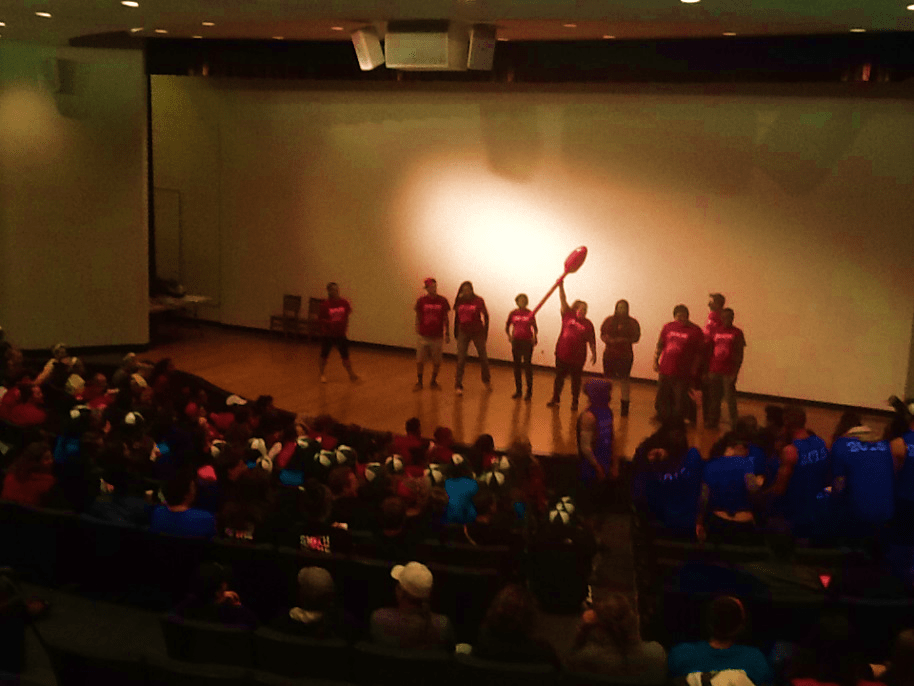
(Residents of Coblentz Hall winning the pink spoon, photos by Chloe Scott)

(Residents of Coblentz Hall winning the pink spoon, photos by Chloe Scott)

Chloe Scott

As an annual tradition, Hood College hosts “Policies for Dollars,” for freshman to show their pride and fierce competition among the residence halls. On the evening of Oct. 26, campus residents initiated the nights’ festivities with a battle on the quad.
The event entails residence halls participating in a competition for extra House Council money and the Pink Spoon. The main events for the evening included an obstacle course, chants, skits and jeopardy. With the assistance of House Council Officers, first-year students, who served as representatives, were tasked with the main duty of planning and coordination for the four main events. Each event can help the hall gain points to win.

(Hood College Freshmen with the pink spoon, photos by Chloe Scott)

(Hood College Freshmen with the pink spoon)

When seeing all the excitement, and hearing the chants from students on the quad proceed through Whitaker Campus Commons, Senior Maya Gonzalez recalled her experience with “Policies for Dollars”. She was sad to say that the tradition of the event is slowly dying. “Students are losing interest, especially upperclassman who had their first experience three years ago. I don’t know why it’s dying out, but if we could revamp ‘Policies for Dollars’ for better understanding of it, we could possibly strengthen it for future first-year students,” Gonzalez said.
Director of Residence Life and Student Conduct, Matt Troutman is a newcomer to the event this year. “My first impression of ‘Policies for Dollars’ was that it sounded like an amazing student-driven program,” Troutman said. “My first couple of weeks at Hood, the students told me it was their favorite memory and tradition.” Having worked at other institutions, he commented that it is a rare blessing when students are so excited about an event, especially one affiliated with residence life and dealing with campus policies. Troutman advises House Forum, which is a group of representatives from each of the House Councils. House Forum helps to plan the program by making some decisions and communicating back with the House Councils. Before the event Troutman stated “I am looking forward to the event. I will be assisting with certain aspects such as running the Jeopardy game. I also am looking forward to observing with an eye of how we can make improvements next year, as well as just being entertained (especially with the skits).” Other faculty in attendance included President Andrea Chapdelaine, Dean Olivia White, and Chief Thurmond Maynard as judges for the event.

(Students of Memorial Hall)

(Students of Memorial Hall)

Although the skits provide entertainment to students, they are also meant to be a further learning experience of campus policies. The skit and jeopardy portion of Policies for Dollars, held in the Hodson Auditorium, showcases each hall’s knowledge of policies and questions pertaining to Hood College. One of the residence halls, Shriner Hall, skits consisted of a storyline with Alice and Wonderland characters. The Madhatter and Alice were roommates and he broke a lot of policies and made poor decision making. Examples of jeopardy questions include when Hood College was founded and what the myth of the Pergola is.
Shriner Hall resident Shelby Alcorn commented that “Policies for Dollars” brings everyone together. “Bringing people together is a part of what Hood is good at. I love the experience,” Alcorn said. Senior Carmelita Ugarte enjoyed watching the skits for the evening. “I usually buy a shirt to support the first-year students for Policies for Dollars,” Ugarte said. The team to take the win for the evening was Coblentz Hall.

Filed Under: news Tagged With: college, college pride, freshmen, Hood College, policies for dollars

Apple Distinguished School, Hood College, Integrates iPads into the Classroom

November 2, 2015 by admin

By: Rebecca DeLauter

In 2014, Hood College was recognized as an Apple Distinguished School for its plan to use iPad technology as a teaching tool. The program, initially aided by an anonymous alumni donor, caused controversy on whether giving students iPads would really enhance their education. Hood initially geared the pilot program toward moving away from physical textbooks to e-books.

ipad1

(Photos by Rebecca DeLauter)

The school began this process in 2011. Four years later, student and faculty opinions still vary on whether Hood’s mission to further education through the iPads is successful.
Many students agree that the root of the controversy lies in the faculty. They say some of their professors don’t allow the iPads, while others encourage use of them, as well as make them a part of lesson plans.
“About half of my teachers allow them, and half of them forbid them, “Ariana LeBlanc, a junior, said. “I never know what to expect.”
LeBlanc, a biology major, also said that she mainly uses her iPad for social media and entertainment purposes. She said that the iPad does help her escape from the stresses of school. When she needs to take a break from school work, she watches Netflix and plays on the iPad.
Two freshmen, Tyler Heffner and Ryan Atkinson said they don’t use their iPads for much.
“I’m really excited to have the iPad, but I kind of see it as a waste of money,” Atkinson said.
And Heffner agreed that the iPads are “pointless” when using them for school.

Chris Hamby

(Chris Hamby)

But some upperclassmen said that they began using their iPads more as they began taking higher-level classes. One senior, Kristine Johnson said that she thinks it’s because of experience—professors think students aren’t going to get as distracted later in their college careers. After Johnson transferred to Hood from Frederick Community College, she majored in biology and received her iPad.
“Most of my classes now only have juniors and seniors,” she said. “Professors trust us more.”
Senior Tiffany Kiang agrees, but she thinks that it also depends on which major you choose. Kiang is an English major and pursuing a secondary education certification as well.
She said: “Since there’s such an emphasis placed on education in technology these days, my education professors are starting to use the iPads now, and my English classes are the same. But if I was a bio major, I don’t think I’d use it as often because biology is more hands-on.”
Kiang did say she sees more professors using them each year—and not just for textbooks, but for valid teaching tools as well.
One professor at Hood works hard to promote the use of iPads in the classroom, and makes having an iPad a requirement in her classes. Heather Mitchell-Buck, a professor of English at Hood, integrates iPads into her curriculum.
Mitchell-Buck believes that the role of a teacher is less about giving information, but about giving the tools to learn how to get it. She likes the “size and portability” of the iPads, and said that iPads break a barrier that laptops can create in the classroom.

Kristine Johnson

(Kristine Johnson)

Recently, Mitchell-Buck became an Apple distinguished educator, which recognizes teachers and professors around the world for use of Apple technology in the classroom.
On her website, she admits on the home page that she is “unabashedly addicted” to her iPad. She also describes her vision for using the iPad, and why she uses it in the classroom.
“The more hands-on you can be when learning, the more those lessons stick with you,” she said.
Mitchell-Buck works as a sort of advocate for using Apple technology in the classroom. She said that she doesn’t think forcing faculty to use them will work at all. Instead she relies on having informal conversations with her coworkers.
She is also on the advisory committee for Hood’s Center for Teaching and Learning, which holds workshops for professors on how to better implement iPad technology into the classroom.
She said that this semester, students in her classes will be required to submit final projects created entirely through iPad technology. One app she likes to use is called NearPod, which is a teaching tool she uses to create interactive lessons for students. Instead of using a traditional slideshow to teach key points in her literature classes, she uploads one to NearPod so students can have a hand-held version of her lesson.
Mitchell-Buck said she realizes the use of iPads holds much controversy in the education world, but she believes that people should look at what’s practical.
“People expect you to know how to use technology when getting a job,” she said. “It’s a good edge for people.”
She described using iPads as the “low diving board” for students—a “low stakes” way of getting people to try something new.

Filed Under: news Tagged With: Apple Distinguished School, controversy, education, Hood College, Ipad's, School, Technology

President Chapelaine Inaugurated as Hood College’s 11th President

November 2, 2015 by admin

 Carly Berkowitz

Inauguration of President Chapdelaine

(Inauguration of President Chapdelaine, Photos by Berkowitz)

Students, staff, and esteemed guests alike stood in honor and applauded as Dr. Andrea Chapdelaine took the stage to officially become the 11th president of Hood College.
The ceremony started at 2 p.m. on Saturday, Oct. 17 in the Hodson Outdoor Theater on campus. The autumn wind was cold against hands and faces, but the reception of the guests from the Hood community was still warm as the long-awaited ceremony began.
Chapdelaine officially began her work as president back in July, but now, with great celebration, pomp, and circumstance, it becomes official.
“I’m very passionate about small liberal arts colleges,” Chapdelaine said in an interview prior to the event. She expressed her interest in the challenges and opportunities Hood presents, as well as the Hood community. “I want us to continue to be a strong institution so I will be working on continuing to gather resources, with primary interest in improving the academic experience of the students.”
The inauguration boasted many visitors and guest speakers, including Dr. Lex O. McMillan III, president of Albright College; Dr. Jennie C. Hunter-Cevera, the secretary for the Maryland Higher Education Commission; Bud Otis, president of the Frederick County Council; Col. Robert A. O’Brien IV, commander for the U.S. Army Garrison at Fort Detrick; MaryAnn Baenninger, president of Drew University and board member of the National Association of Independent Colleges and Universities; Tina Bjarekull, president of the Maryland Independent College and University Association; along with Hood alumnae and faculty alike.
The week leading up to the ceremony, Hood hosted many events to build excitement for the coming inauguration. Students could watch inauguration improvisation, take part in a scavenger hunt, or help their community through Civic Engagement Awareness week, among others gatherings, assemblies, and lectures.

Inauguration of President Chapdelaine

Inauguration of President Chapdelaine

Chapdelaine herself came up with the idea for Civic Engagement Awareness week, explaining that it serves as a celebration of Hood and all it brings to the surrounding community. “I had certain goals for the inauguration, one is that the students have fun and feel engaged and part of it – that was my primary goal,” Chapdelaine explained. “The second was that it showcase not just me but all of the things that we should be proud of in terms of what Hood is – how much Hood does for the community – the civic engagement week really came out of that.” Chapdelaine also expressed her hope that Civic Engagement Awareness week become an annual event.
Immediately following the inauguration, students, staff, faculty and guests were welcome to enjoy light refreshments in front of the Coblentz dining hall and each others’ company. The air was one of celebration, as everyone intermingled on the quad.
“I think the inauguration was a great celebration and I look forward to her [President Chapdelaine’s] time as president with a great deal of hope and promise,” said Katherine Orloff, assistant professor of journalism at Hood. “I think she is a kind heart with a genuine interest in improving our college, and my general feeling is that the faculty is pretty united in doing whatever we can to support her.”
Other Hood faculty shared a very similar opinion. “Overall I thought the inauguration was quite delightful, a lot of fun,” said Donna Bertazonni, professor of journalism and director of the Communication Arts program at Hood. “It’s been very enjoyable – I thought that the ceremony was quite nice – I really liked what President Chapdelaine said, but I also really liked what the president of Albright said. I thought that was very, very nice, bringing her and all of her accomplishments to light for the rest of us.”
“I think it’ll be a good future, I’m looking forward to it,” added Dr. Heather Mitchell-Buck, assistant professor of English.
A video of the inauguration was posted to the Hood College website shortly after the event. There is also a webpage posted for anyone wanting to bid good luck and best wishes to President Chapdelaine for the future.

Filed Under: lead, news Tagged With: Civic Engagement Awareness Week, Hood College, Inauguration, President Chapdelaine

Hood’s Witch Trial Reenactment Highlights Continuing Issues

November 2, 2015 by admin

Cameron Rogers

CR3

(Jennifer Forester, photos by Rogers)

As part of the Halloween season, Hood College’s English 259 course held a reenactment of a Medieval European witch trial on Oct. 27.
The course, which is entitled “Medieval Magic and Mysticism,” studies literature involving witchcraft and the growing fear of it between the years 400-1800 C.E. The class prepared for the reenactment throughout the month of October.
The reenactment lasted from 1 to 2 p.m. in room 131 of Hodson Science and Technology Center.
“Finding the time and space to do it was kind of a challenge,” Dr. Heather Mitchell-Buck, the instructor of the course, said.
According to Mitchell-Buck, she did not act as a gatekeeper for the reenactment’s content. “I helped facilitate some discussions in the creation of the project. But, I was there not to make suggestions, but mostly just to keep the conversation going and keep it productive.”
The reenactment will serve two purposes according to the class – to demonstrate to Hood students everything they learned over the first half of the semester, and to highlight the continued existence of one-sided “witch trials” today.
Mitchell-Buck said that she believed the historical witch trials still had relevance today. “Think about any time you see people accused of something without sufficient evidence in support of that, or you see a community looking to blame someone who is different from themselves for something that they don’t entirely understand.”

CR4

Peter Routson, Kassandra Stout, and Grant Kane

Logan Samuels, a student in the course, agreed with Mitchell-Buck’s sentiments. “I think it can play into today,” she said. “I would like to say we don’t slip up as much as we do, but there are definitely some biases when it comes to trials with celebrities and politicians.”
Samuels’ role in the reenactment was to decide each sentence for the “accused” individuals.
Samuels compared the sentencing of witch trials to court cases today, where the wealthy and powerful would often go free with little to no punishment. In keeping with the references to modernity, she said that modern humor would be written into the script.
In contrast, Ashley Trovato, another student in ENGL 259, did not hold the same views on modern relevance. “The scare isn’t even relevant at all,” she said. She pointed towards the modern focus on science and acceptance of customs that would have been mistaken for witchcraft as signs of societal progress.
Trovato, who designed the propaganda and handout flyers for the reenactment, said she hoped people would still take the event seriously.
The reenactment itself carried on the theme of false accusations and distrust of outsiders. Of the three people accused (a priest, a noblewoman, and an old midwife), only the latter was convicted and executed, while the former two received light sentences.
The audience received verdicts of their own on cards handed out before the show began. Opening them after the Q&A panel revealed a unique accusation and verdict based on hearsay, with punishments ranging from fasting to being set on fire.

CR5

It was not the first time Mitchell-Buck’s class held a witch trial reenactment. In 2013, her Magic and Mysticism class reenacted both a pre-Protestant Reformation and post-Protestant Reformation trial.
The class was overall excited for the production on Tuesday.
“I hope it’s a good Halloween event,” Samuels said. “I think it’s just going to really be unique, and I’m excited to see what happens.”
Likewise, Mitchell-Buck expressed her enthusiasm for the efforts of her students. “It is going to be awesome,” she said. “I think there’s all kind of social relevance to this today.”
Ultimately, she said that she hoped the audience would understand where the fear and prejudice of the time period came from. “I hope that they get a little nuanced sense of what went into this than what we get from Monty Python,” she said.

Filed Under: lead, news Tagged With: English Literature, Halloween, Hood College, Medieval Magic and Mysticism, witch trial reenactment

Ash Beckham

November 2, 2015 by admin

Shannon Jones

Students, staff, and faculty gathered to see Tedx speaker Ash Beckham present her talk “Give Voice to Your Truth” on Wednesday, Oct. 27 in the Brodbeck Music Hall.
In this talk, Beckham, who considered herself an “accidental advocate” for the LGBTQ community, addressed the importance of empathy and acceptance and shared her own experiences to engage the audience. The main idea of this talk was “creating a more empathetic community on campus,” she said, and bringing that empathy into other communities as well.
“The first step is to embrace the diversity that we all bring, to embrace our own differences,” Beckham said, “and be willing to share our own stories so people better understand us.”
Beckham went through and talked about the importance of each word in the title of her speech, “Give Voice To Your Truth,” and what they mean. She started with the word “Truth,” which, to her, is simply “the fire inside us.” She also discussed the words “tolerance” and “acceptance” and how they differ from each other.
“Tolerating isn’t enough. We need to get to the point of acceptance,” Beckham said. “The difference is tremendous.”
Beckham also discussed how to deal with people who do not show acceptance or do not understand. “We have to acknowledge the fact that the words we choose affect other people,” she said after sharing stories of how she lost her temper with people who were rude towards her.
“I eventually realized I wanted to be a passionate cause for change,” Beckham said. “I wanted to maintain my veracity, but also have some serenity and some kindness, and not lose who I was generally as a person to the anger these situations were bringing me.”
The event drew a substantial crowd consisting of students, faculty, and staff.
“I thought it was really interesting,” said Joe Denicola, a senior at Hood College who attended the event. “I really didn’t think much about the way that you give your own voice, especially not in the way she talked about where you try to find a balance. It doesn’t always have to be confrontational. I never really thought of it that way, mostly because I’m used to more harsher settings, where it’s kind of like, “You’ve got to know this thing or else you’re a horrible person” and the fact that it kind of steered away from that was really cool for me.”

Filed Under: news

Meaning of Life Lecture

November 2, 2015 by admin


Breann Harwood

The meaning of life is something that almost anyone, but especially college students, tend to struggle with. Between making major life choices, deciding on a major, and where they will go after graduation, college students are faced with many pressing questions about what to do with their lives.
On Tuesday, Oct. 20, around 100 students, faculty, and community members joined Hood College as they welcomed social psychologist Laura King. King’s lecture was about “what science can tell us about the meaning of life.” This lecture was in conjunction with the inauguration festivities of Hood’s new president, President Andrea Chapdelaine.
Respectfully so, King started out her lecture by paying honor to President Chapdelaine, who coincidentally majored in social psychology, and told the audience that they were lucky to have a social psychologist as a President; she can change the campus and the world. She then explored how happiness is equivalent to the experience of meaning; however, she emphasized how she was not a positive psychologist, and in fact, found many things skewed with that philosophy.
King explained that there are many people who have “pretty good lives” and it’s these “pretty good lives” that are full of meaning.
“We see the good life all the time,” King said. “We just need to notice it.”
Scientifically, King asserts, that maybe noticing is even more important than inventing. Certainly, she explains that there is value to both, but someone wouldn’t need an invention if they noticed something new, already existing.
The meaning of life, to King, is a paradox. It is ineffable but adaptive and anything that we require in life, to help bring about this meaning must be easy or else no one would say their life is meaningful.
“The meaningful of life happens even if we don’t want it to. There are signs everywhere and we can’t just turn the meaning on or off,” King said.
She then shared with the audience one of her studies about parents who have children with down syndrome. She asked a variety of these people about their experiences and their rate of how meaningful their life is. Almost all of them rated around 5 out of 7, which is significantly higher than the average “meaningful life” at 3.8.
Other populations that hold a higher meaning of life include those who live in poorer nations. King said that this is overwhelmingly due to the fact they have a stronger religious foundation.
King assured the audience that every one of them already had a meaningful life because they all had the integral parts to what is “meaningful.” Every single person already lives in a world that makes sense and that thrives off of habit and routine; the cornerstone to homeostasis.
“The biggest thing that I took away from Dr. King’s lecture is that everyone has meaning in their life, even though it’s sometimes hard to see, and that the biggest problem isn’t that we think our lives have too much meaning, but that our lives have no meaning,” Senior Aleyna Fitz said.
King said that one of the strongest correlations in rating a positive meaning in life is helping others. Helping people and volunteering creates a direct connection to a higher rate of meaning, so much so that King suggests there may not truly be such a thing as altruism.
She then concludes her lecture by asking the audience, “What are you going to do with your one extraordinarily meaningful life?”
“I like how she said that everyone’s life has meaning and that if one of us wasn’t here, right now, we would notice,” Junior Naila Stocks said. “We all matter; we all are the meaning of life.”

Filed Under: news

  • 1
  • 2
  • Next Page »

Archives

  • November 2015
  • October 2015
  • August 2015

Thank you for reading.

Copyright © 2026 · News Pro Theme on Genesis Framework · WordPress · Log in