Online Journalism Today

Designed by Katie Stout

  • lifestyle
  • sports
  • About
  • Hood College

Freshmen Show their Pride in Policies for Dollars

November 4, 2015 by admin


(Residents of Coblentz Hall winning the pink spoon, photos by Chloe Scott)

(Residents of Coblentz Hall winning the pink spoon, photos by Chloe Scott)

Chloe Scott

As an annual tradition, Hood College hosts “Policies for Dollars,” for freshman to show their pride and fierce competition among the residence halls. On the evening of Oct. 26, campus residents initiated the nights’ festivities with a battle on the quad.
The event entails residence halls participating in a competition for extra House Council money and the Pink Spoon. The main events for the evening included an obstacle course, chants, skits and jeopardy. With the assistance of House Council Officers, first-year students, who served as representatives, were tasked with the main duty of planning and coordination for the four main events. Each event can help the hall gain points to win.
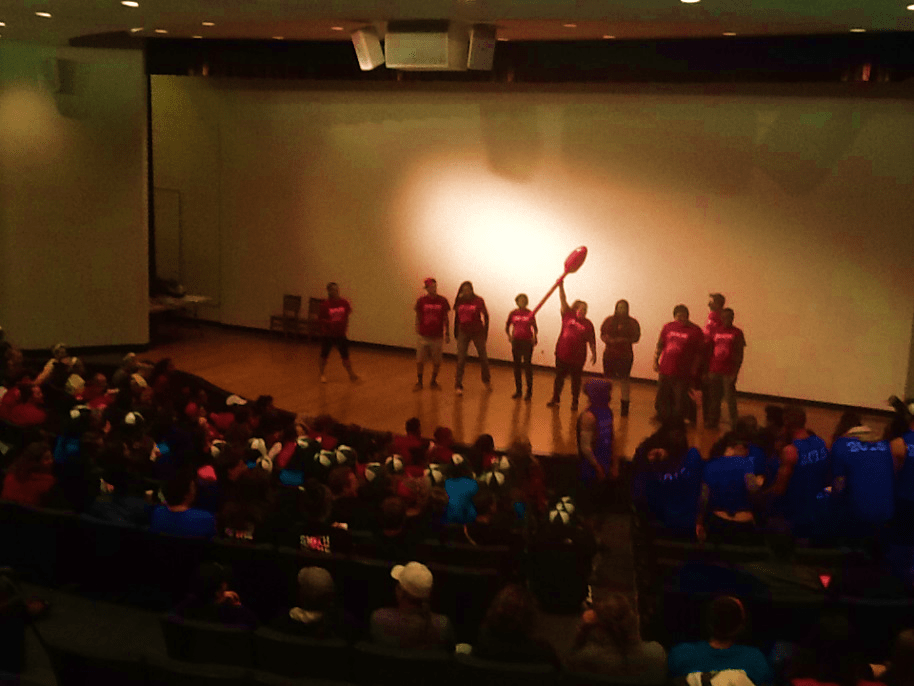
(Hood College Freshmen with the pink spoon, photos by Chloe Scott)

(Hood College Freshmen with the pink spoon)

When seeing all the excitement, and hearing the chants from students on the quad proceed through Whitaker Campus Commons, Senior Maya Gonzalez recalled her experience with “Policies for Dollars”. She was sad to say that the tradition of the event is slowly dying. “Students are losing interest, especially upperclassman who had their first experience three years ago. I don’t know why it’s dying out, but if we could revamp ‘Policies for Dollars’ for better understanding of it, we could possibly strengthen it for future first-year students,” Gonzalez said.
Director of Residence Life and Student Conduct, Matt Troutman is a newcomer to the event this year. “My first impression of ‘Policies for Dollars’ was that it sounded like an amazing student-driven program,” Troutman said. “My first couple of weeks at Hood, the students told me it was their favorite memory and tradition.” Having worked at other institutions, he commented that it is a rare blessing when students are so excited about an event, especially one affiliated with residence life and dealing with campus policies. Troutman advises House Forum, which is a group of representatives from each of the House Councils. House Forum helps to plan the program by making some decisions and communicating back with the House Councils. Before the event Troutman stated “I am looking forward to the event. I will be assisting with certain aspects such as running the Jeopardy game. I also am looking forward to observing with an eye of how we can make improvements next year, as well as just being entertained (especially with the skits).” Other faculty in attendance included President Andrea Chapdelaine, Dean Olivia White, and Chief Thurmond Maynard as judges for the event.
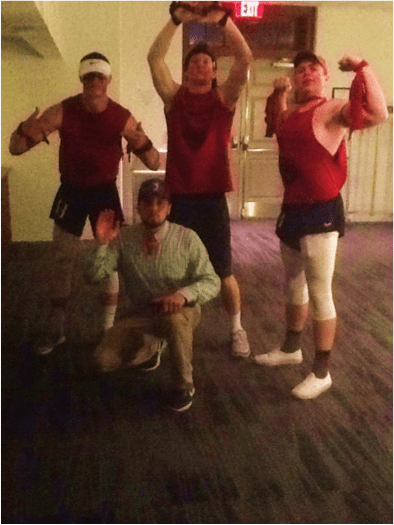
(Students of Memorial Hall)

(Students of Memorial Hall)

Although the skits provide entertainment to students, they are also meant to be a further learning experience of campus policies. The skit and jeopardy portion of Policies for Dollars, held in the Hodson Auditorium, showcases each hall’s knowledge of policies and questions pertaining to Hood College. One of the residence halls, Shriner Hall, skits consisted of a storyline with Alice and Wonderland characters. The Madhatter and Alice were roommates and he broke a lot of policies and made poor decision making. Examples of jeopardy questions include when Hood College was founded and what the myth of the Pergola is.
Shriner Hall resident Shelby Alcorn commented that “Policies for Dollars” brings everyone together. “Bringing people together is a part of what Hood is good at. I love the experience,” Alcorn said. Senior Carmelita Ugarte enjoyed watching the skits for the evening. “I usually buy a shirt to support the first-year students for Policies for Dollars,” Ugarte said. The team to take the win for the evening was Coblentz Hall.

Filed Under: news Tagged With: college, college pride, freshmen, Hood College, policies for dollars

Vegan Friendly Options at Hood College

November 2, 2015 by admin


food2

(Hood College Dining Hall, photos by Woodward Becerra)

Paul Woodward Becerra

In the wake of Meatless Mondays, a growing vegan movement, and a public investment in health and environmental consciousness, the number of people adopting a vegan diet has grown dramatically in the last decade.
Now, over 16 million people in the U.S. identify as vegan or vegetarian and countless others strive to reduce their meat consumption, placing a mounting pressure on our institutions of higher education to consistently serve quality plant-based foods.
How does Hood College stack up in providing vegan options? The popular “PETA College Report Card”, a system of rating colleges based on their vegan menu offerings, hasn’t been completed for the small school.
For any campus, having multiple food outlets makes the task of assigning ratings difficult — Hood’s campus has the Dining Hall, Grilleworks, and Peet’s Coffee, all offering different menus, and with them, varying levels of food-friendliness.

food3
Hood’s Coblentz Dining Hall has a staff and menu managed by Aramark, the Philadelphia food-service company that handles feeding everyone from Wal-Mart’s employees to people at the ball game. Just this year, they’ve introduced over 500 new vegan options to colleges and, amazingly, managed to breach the often meat-centric world of sports with vegetarian and vegan baseball concessions.
Highlights of the Dining Hall are a Silk soymilk dispenser, an always-available vegan entrée (usually with two vegan side dishes), and a dedicated mini-fridge with vegan condiments like parmesan, butter, cream cheese, and mayonnaise. Along with a good selection of fresh fruits and vegetables at the salad bar, anyone eating vegan can get a healthy meal when they want to.
At the entrance of the Dining Hall, an Aramark-supplied placard sits, hidden behind waffle irons. It reads “Our Commitments,” listing the ethos of the company. A graphic of peas peeks out from the top, set next to the text “We provide a vegetarian friendly environment with a variety of vegetarian or vegan choices.”

(Hood College Dining

For Jen Clark, the head of Dining Services at Hood College, finding the demographic is hard. “One thing we like to know is the amount of people that we’re catering to . . . I don’t know how many vegans are on Hood’s campus.” However, this doesn’t stop her from doing her best.

“I am trying to make sure that for every meal, we have options,” she stated proudly, noting that some of the larger clients for Aramark’s dining services have their own vegan facilities.
Since she came into service as the director Hood’s Dining Services, Jen has implemented landmark changes. She’s instituted Aramark policies such as Meatless Mondays, and desserts free of animal products. Even better, she’s putting in the legwork to create her own programs to make sure students are represented.

food4

Starting this year, Jen started “Dine with the Director”, a monthly meeting where students can provide criticism and feedback about on-campus food to Jen, which she uses to make changes in their interest. This came when she learned about the overwhelming number students who shared their feelings about on-food campus on social media: she wanted to close the open feedback loop that didn’t include the party that counted most. The program is having some trouble getting traction, but she’s not deterred.
All in all, the dining experience is steadily improving for vegans on campus at Hood College. Even when addressing the many areas that need improvement, Jen gave a smile and said “I’m working on it.”

Filed Under: lifestyle Tagged With: Dining Hall, Food, Hood College, Meatless Monday, Vegan, Vegetarian

Apple Distinguished School, Hood College, Integrates iPads into the Classroom

November 2, 2015 by admin

By: Rebecca DeLauter

In 2014, Hood College was recognized as an Apple Distinguished School for its plan to use iPad technology as a teaching tool. The program, initially aided by an anonymous alumni donor, caused controversy on whether giving students iPads would really enhance their education. Hood initially geared the pilot program toward moving away from physical textbooks to e-books.

ipad1

(Photos by Rebecca DeLauter)

The school began this process in 2011. Four years later, student and faculty opinions still vary on whether Hood’s mission to further education through the iPads is successful.
Many students agree that the root of the controversy lies in the faculty. They say some of their professors don’t allow the iPads, while others encourage use of them, as well as make them a part of lesson plans.
“About half of my teachers allow them, and half of them forbid them, “Ariana LeBlanc, a junior, said. “I never know what to expect.”
LeBlanc, a biology major, also said that she mainly uses her iPad for social media and entertainment purposes. She said that the iPad does help her escape from the stresses of school. When she needs to take a break from school work, she watches Netflix and plays on the iPad.
Two freshmen, Tyler Heffner and Ryan Atkinson said they don’t use their iPads for much.
“I’m really excited to have the iPad, but I kind of see it as a waste of money,” Atkinson said.
And Heffner agreed that the iPads are “pointless” when using them for school.

Chris Hamby

(Chris Hamby)

But some upperclassmen said that they began using their iPads more as they began taking higher-level classes. One senior, Kristine Johnson said that she thinks it’s because of experience—professors think students aren’t going to get as distracted later in their college careers. After Johnson transferred to Hood from Frederick Community College, she majored in biology and received her iPad.
“Most of my classes now only have juniors and seniors,” she said. “Professors trust us more.”
Senior Tiffany Kiang agrees, but she thinks that it also depends on which major you choose. Kiang is an English major and pursuing a secondary education certification as well.
She said: “Since there’s such an emphasis placed on education in technology these days, my education professors are starting to use the iPads now, and my English classes are the same. But if I was a bio major, I don’t think I’d use it as often because biology is more hands-on.”
Kiang did say she sees more professors using them each year—and not just for textbooks, but for valid teaching tools as well.
One professor at Hood works hard to promote the use of iPads in the classroom, and makes having an iPad a requirement in her classes. Heather Mitchell-Buck, a professor of English at Hood, integrates iPads into her curriculum.
Mitchell-Buck believes that the role of a teacher is less about giving information, but about giving the tools to learn how to get it. She likes the “size and portability” of the iPads, and said that iPads break a barrier that laptops can create in the classroom.

Kristine Johnson

(Kristine Johnson)

Recently, Mitchell-Buck became an Apple distinguished educator, which recognizes teachers and professors around the world for use of Apple technology in the classroom.
On her website, she admits on the home page that she is “unabashedly addicted” to her iPad. She also describes her vision for using the iPad, and why she uses it in the classroom.
“The more hands-on you can be when learning, the more those lessons stick with you,” she said.
Mitchell-Buck works as a sort of advocate for using Apple technology in the classroom. She said that she doesn’t think forcing faculty to use them will work at all. Instead she relies on having informal conversations with her coworkers.
She is also on the advisory committee for Hood’s Center for Teaching and Learning, which holds workshops for professors on how to better implement iPad technology into the classroom.
She said that this semester, students in her classes will be required to submit final projects created entirely through iPad technology. One app she likes to use is called NearPod, which is a teaching tool she uses to create interactive lessons for students. Instead of using a traditional slideshow to teach key points in her literature classes, she uploads one to NearPod so students can have a hand-held version of her lesson.
Mitchell-Buck said she realizes the use of iPads holds much controversy in the education world, but she believes that people should look at what’s practical.
“People expect you to know how to use technology when getting a job,” she said. “It’s a good edge for people.”
She described using iPads as the “low diving board” for students—a “low stakes” way of getting people to try something new.

Filed Under: news Tagged With: Apple Distinguished School, controversy, education, Hood College, Ipad's, School, Technology

President Chapelaine Inaugurated as Hood College’s 11th President

November 2, 2015 by admin

 Carly Berkowitz

Inauguration of President Chapdelaine

(Inauguration of President Chapdelaine, Photos by Berkowitz)

Students, staff, and esteemed guests alike stood in honor and applauded as Dr. Andrea Chapdelaine took the stage to officially become the 11th president of Hood College.
The ceremony started at 2 p.m. on Saturday, Oct. 17 in the Hodson Outdoor Theater on campus. The autumn wind was cold against hands and faces, but the reception of the guests from the Hood community was still warm as the long-awaited ceremony began.
Chapdelaine officially began her work as president back in July, but now, with great celebration, pomp, and circumstance, it becomes official.
“I’m very passionate about small liberal arts colleges,” Chapdelaine said in an interview prior to the event. She expressed her interest in the challenges and opportunities Hood presents, as well as the Hood community. “I want us to continue to be a strong institution so I will be working on continuing to gather resources, with primary interest in improving the academic experience of the students.”
The inauguration boasted many visitors and guest speakers, including Dr. Lex O. McMillan III, president of Albright College; Dr. Jennie C. Hunter-Cevera, the secretary for the Maryland Higher Education Commission; Bud Otis, president of the Frederick County Council; Col. Robert A. O’Brien IV, commander for the U.S. Army Garrison at Fort Detrick; MaryAnn Baenninger, president of Drew University and board member of the National Association of Independent Colleges and Universities; Tina Bjarekull, president of the Maryland Independent College and University Association; along with Hood alumnae and faculty alike.
The week leading up to the ceremony, Hood hosted many events to build excitement for the coming inauguration. Students could watch inauguration improvisation, take part in a scavenger hunt, or help their community through Civic Engagement Awareness week, among others gatherings, assemblies, and lectures.

Inauguration of President Chapdelaine

Inauguration of President Chapdelaine

Chapdelaine herself came up with the idea for Civic Engagement Awareness week, explaining that it serves as a celebration of Hood and all it brings to the surrounding community. “I had certain goals for the inauguration, one is that the students have fun and feel engaged and part of it – that was my primary goal,” Chapdelaine explained. “The second was that it showcase not just me but all of the things that we should be proud of in terms of what Hood is – how much Hood does for the community – the civic engagement week really came out of that.” Chapdelaine also expressed her hope that Civic Engagement Awareness week become an annual event.
Immediately following the inauguration, students, staff, faculty and guests were welcome to enjoy light refreshments in front of the Coblentz dining hall and each others’ company. The air was one of celebration, as everyone intermingled on the quad.
“I think the inauguration was a great celebration and I look forward to her [President Chapdelaine’s] time as president with a great deal of hope and promise,” said Katherine Orloff, assistant professor of journalism at Hood. “I think she is a kind heart with a genuine interest in improving our college, and my general feeling is that the faculty is pretty united in doing whatever we can to support her.”
Other Hood faculty shared a very similar opinion. “Overall I thought the inauguration was quite delightful, a lot of fun,” said Donna Bertazonni, professor of journalism and director of the Communication Arts program at Hood. “It’s been very enjoyable – I thought that the ceremony was quite nice – I really liked what President Chapdelaine said, but I also really liked what the president of Albright said. I thought that was very, very nice, bringing her and all of her accomplishments to light for the rest of us.”
“I think it’ll be a good future, I’m looking forward to it,” added Dr. Heather Mitchell-Buck, assistant professor of English.
A video of the inauguration was posted to the Hood College website shortly after the event. There is also a webpage posted for anyone wanting to bid good luck and best wishes to President Chapdelaine for the future.

Filed Under: lead, news Tagged With: Civic Engagement Awareness Week, Hood College, Inauguration, President Chapdelaine

Hood’s Witch Trial Reenactment Highlights Continuing Issues

November 2, 2015 by admin

Cameron Rogers

CR3

(Jennifer Forester, photos by Rogers)

As part of the Halloween season, Hood College’s English 259 course held a reenactment of a Medieval European witch trial on Oct. 27.
The course, which is entitled “Medieval Magic and Mysticism,” studies literature involving witchcraft and the growing fear of it between the years 400-1800 C.E. The class prepared for the reenactment throughout the month of October.
The reenactment lasted from 1 to 2 p.m. in room 131 of Hodson Science and Technology Center.
“Finding the time and space to do it was kind of a challenge,” Dr. Heather Mitchell-Buck, the instructor of the course, said.
According to Mitchell-Buck, she did not act as a gatekeeper for the reenactment’s content. “I helped facilitate some discussions in the creation of the project. But, I was there not to make suggestions, but mostly just to keep the conversation going and keep it productive.”
The reenactment will serve two purposes according to the class – to demonstrate to Hood students everything they learned over the first half of the semester, and to highlight the continued existence of one-sided “witch trials” today.
Mitchell-Buck said that she believed the historical witch trials still had relevance today. “Think about any time you see people accused of something without sufficient evidence in support of that, or you see a community looking to blame someone who is different from themselves for something that they don’t entirely understand.”

CR4

Peter Routson, Kassandra Stout, and Grant Kane

Logan Samuels, a student in the course, agreed with Mitchell-Buck’s sentiments. “I think it can play into today,” she said. “I would like to say we don’t slip up as much as we do, but there are definitely some biases when it comes to trials with celebrities and politicians.”
Samuels’ role in the reenactment was to decide each sentence for the “accused” individuals.
Samuels compared the sentencing of witch trials to court cases today, where the wealthy and powerful would often go free with little to no punishment. In keeping with the references to modernity, she said that modern humor would be written into the script.
In contrast, Ashley Trovato, another student in ENGL 259, did not hold the same views on modern relevance. “The scare isn’t even relevant at all,” she said. She pointed towards the modern focus on science and acceptance of customs that would have been mistaken for witchcraft as signs of societal progress.
Trovato, who designed the propaganda and handout flyers for the reenactment, said she hoped people would still take the event seriously.
The reenactment itself carried on the theme of false accusations and distrust of outsiders. Of the three people accused (a priest, a noblewoman, and an old midwife), only the latter was convicted and executed, while the former two received light sentences.
The audience received verdicts of their own on cards handed out before the show began. Opening them after the Q&A panel revealed a unique accusation and verdict based on hearsay, with punishments ranging from fasting to being set on fire.

CR5

It was not the first time Mitchell-Buck’s class held a witch trial reenactment. In 2013, her Magic and Mysticism class reenacted both a pre-Protestant Reformation and post-Protestant Reformation trial.
The class was overall excited for the production on Tuesday.
“I hope it’s a good Halloween event,” Samuels said. “I think it’s just going to really be unique, and I’m excited to see what happens.”
Likewise, Mitchell-Buck expressed her enthusiasm for the efforts of her students. “It is going to be awesome,” she said. “I think there’s all kind of social relevance to this today.”
Ultimately, she said that she hoped the audience would understand where the fear and prejudice of the time period came from. “I hope that they get a little nuanced sense of what went into this than what we get from Monty Python,” she said.

Filed Under: lead, news Tagged With: English Literature, Halloween, Hood College, Medieval Magic and Mysticism, witch trial reenactment

The Safe Haven of Safe Harvest

November 2, 2015 by admin

By: Katie Stout

Each year, Hood College hosts Safe Harvest, an annual autumnal celebration that occurs around Halloween, providing local children in Fredrick, with a safe haven to trick or treat.
Hosted by Hood’s Mortar Board Society, Safe Harvest “provides children ages 12 and under the opportunity to enjoy a safe and fun-filled evening of games, arts and crafts, and trick or treating on Hood’s campus,” according to the society’s public relations chairwoman, Sienna Bronson.

This year’s annual Safe Harvest was on Oct. 28th. The Mortar Board Society organizes the event, but the whole Hood College community comes together to make it happen. Students are encouraged to buy candy to either donate or hand out to kids when they walk around the college’s five dorms.
“This year there were so many Hood College organizations involved. We had booths for Archaeology club, FSU, Least Squares Math club, Hood Improv Troupe, CKI club, the BrotherHood, SEA, Belly Dance Club, SGA, Cab, and ALD,” Bronson says.

Dana Lewis, Chloe Jackson, Micaela McCarthy, and Tori Gomez

(Dana Lewis, Chloe Jackson, Micaela McCarthy, and Tori Gomez)

While many students come out and show their support, not all Hood students are enthusiastic about this event. In fact, many students are confused as to why Safe Harvest exists.
Micaela McCarthy, a Hood College junior, says she would “rather have her kids go house-to-house trick or treating than go to a college campus,” if she had kids. Though she sees the point of Safe Harvest, she has never heard of trick or treating being dangerous at all, and asks “is it really necessary?”
While she was a freshman at Hood, Bronson was told that “trick or treating is illegal in downtown Frederick since it is a historic district.” However, she was recently informed that trick or treating is not illegal in Frederick, and that this is simply a rumor.
“Everyone at Hood says Safe Harvest started because trick or treating is illegal, because someone tried to poison kids candy one Halloween. But nobody seems to know exactly what happened,” says Alex Connor, Hood College junior.

kt

(Frederick Residents at Safe Harvest, photos by Stout)

“How and when Safe Harvest began is a bit foggy,” Bronson says. “It was already going in 2003 when Dr. Flora first got here, but I think it has been going on for a while.”
Bronson says, “regardless of why it started, Safe Harvest is a great way for children to experience a myriad of fall and Halloween related activities in a safe place with others around the same age.”

“Current faculty and staff are always in attendance, and alumni who are in Frederick continue to return,” Bronson says. The event is so widely popular because they “open the event to the public, and that draws people in. There are some nearby places where trick or treating is not allowed for various reasons, and lots of people come most likely because of word of mouth.”
Cathy Woodward, Frederick resident, says Safe Harvest is the perfect place for her kids to celebrate Halloween.
Woodward, single mother of two, says, “It is a strange concept of having your kids go door to door asking for candy. The concept is quite strange because you do feel like you are putting your kids lives in the hands of strangers for a bit.”
Woodward goes on to say that trick or treating “is a risk, not just the candy, but what if the stranger is a pedophile or a kidnapper? I do not allow my children to trick or treat, so Safe Harvest is the perfect place to take my kids.”
Bronson says her favorite part of Safe Harvest is seeing the parents and children having a great time in a safe environment. She says it gives “everyone a chance to come together to celebrate Halloween in a shorter span of time with a defined environment.”
“Safe Harvest has been one of my favorite events every year since my first year at Hood,” Bronson says. “The main thing I get out of it is a fun experience that comes with the benefit of doing something good for the community.”


Filed Under: Uncategorized Tagged With: Halloween, Hood College, Mortar Board Society, Safe Harvest, Trick or Treating

Ash Beckham

November 2, 2015 by admin

Shannon Jones

Students, staff, and faculty gathered to see Tedx speaker Ash Beckham present her talk “Give Voice to Your Truth” on Wednesday, Oct. 27 in the Brodbeck Music Hall.
In this talk, Beckham, who considered herself an “accidental advocate” for the LGBTQ community, addressed the importance of empathy and acceptance and shared her own experiences to engage the audience. The main idea of this talk was “creating a more empathetic community on campus,” she said, and bringing that empathy into other communities as well.
“The first step is to embrace the diversity that we all bring, to embrace our own differences,” Beckham said, “and be willing to share our own stories so people better understand us.”
Beckham went through and talked about the importance of each word in the title of her speech, “Give Voice To Your Truth,” and what they mean. She started with the word “Truth,” which, to her, is simply “the fire inside us.” She also discussed the words “tolerance” and “acceptance” and how they differ from each other.
“Tolerating isn’t enough. We need to get to the point of acceptance,” Beckham said. “The difference is tremendous.”
Beckham also discussed how to deal with people who do not show acceptance or do not understand. “We have to acknowledge the fact that the words we choose affect other people,” she said after sharing stories of how she lost her temper with people who were rude towards her.
“I eventually realized I wanted to be a passionate cause for change,” Beckham said. “I wanted to maintain my veracity, but also have some serenity and some kindness, and not lose who I was generally as a person to the anger these situations were bringing me.”
The event drew a substantial crowd consisting of students, faculty, and staff.
“I thought it was really interesting,” said Joe Denicola, a senior at Hood College who attended the event. “I really didn’t think much about the way that you give your own voice, especially not in the way she talked about where you try to find a balance. It doesn’t always have to be confrontational. I never really thought of it that way, mostly because I’m used to more harsher settings, where it’s kind of like, “You’ve got to know this thing or else you’re a horrible person” and the fact that it kind of steered away from that was really cool for me.”

Filed Under: news

Career Center

November 2, 2015 by admin

Gabrielle Cavalier

Hundreds of students entering their first year of college have absolutely no idea what they want to do as a career path. Some think they do, but then change it three years in. What if there was a place a student could go to for career path advice, right on campus? Well, that’s where the Hood College Career Center comes in.
The Career Center, which can be found on the second floor of the Apple building connected to Whitaker, is the place to go to when a student needs an internship, resume critiquing, career help, volunteering opportunities, etc. The Career Center has plenty of options for students to engage in networking and finding a job after college that is suitable for them.
Lana Veres, the Manager of Experiential Learning Programs, believes that gaining career experience through an internship is ideal if the student wants real world skills that apply to their major.
Alissa Hart, the Career Development Program Manager, helps students make a perfect resume and also organizes volunteer opportunities, such as the Civic Engagement week during fall break where students volunteers all over Frederick County.

Filed Under: Uncategorized

Emotional Support Animals

November 2, 2015 by admin

Ashley Trovato

An Emotional Support Animal is, according to the writers at anxiety.org, and The National Animal Registry, “an Emotional Support Animal (ESA) is an animal that, by its very presence, mitigates the emotional or psychological symptoms associated with a handler’s condition or disorder.”
In a college environment, students are always trying to find a way to relieve stress, anxiety, and frustration. Some find it in drinking or other recreational activities, but one way that seems to help is animal interaction.
At Hood College, students are allowed to have Hermit Crab or Goldfish. They are also permitted other animals, but have to go through the CAAR Center first.
Megan Poole, a senior at Hood College, recounts her experience in obtaining permission to bring a service animal on campus. “It was awful.” Megan said, “The process should not have been as hard as it was.”
Poole is diagnosed with; PTSD, severe clinical depression/anxiety, and ADHD. She was permitted to have an animal last year, which was a guinea pig named angel, and it took over a month to obtain permission. Since she stopped seeing a psychiatrist, they took that privilege away.
“Psychiatrists are expensive and hard to keep seeing,” Poole said, “I had to stop seeing mine which resulted in me loosing permission for my piggy.”
“Not having Angel around after I come home from work or class makes me feel worried because I am alone and have nothing to help me with my stress,” Poole said. “Having her last year made stress easier to handle because when I was upset, I would want to cry so I would cuddle her for hours and feel better.”
“I still have Angel at home and she has literally been the difference between life and death for me,” Poole said. “Without her at school with me, I feel lost.”
A student who graduated Hood College, Chelsea Laurens, agrees with Poole. “I have three yorkies, and they 100 percent help me,” Laurens said, “When I was at school and couldn’t have a dog for a couple years I felt like ‘I was missing something’,” she continued by describing how having “something love you unconditionally, no matter what, is a feeling that is indescribable.”
A therapist not affiliated to the school, but helps with college aged students, has provided approval for some of her clients to have an ESA. “I am always looking to find new ways to help my patients with mental health diagnosis,” Whitney Thompson, LCPC (Licensed Clinical Professional Counselor), of The Counseling Renaissance, said. “Medication can be helpful, but a pet who shows unconditional love can help to decrease symptoms. Sometimes, clients need something more than just learning coping skills.” Thompson brings her dog, Bodhi, to work. He is a certified therapy pet.
Anthony Belnomi, a Hood Alum, said that animals are there to listen. He believes animals act on a level farther than cuddling, “As humans we crave company and companionship. Sometimes connections are stronger without words. With animals, there are no words, just sounds,” Belnomi continues, “Animals calm my mind and restores my faith in the world because animals are genuine in both intent and action.”
A junior, Bj Daise said, “If I had a dog jump into my arms, especially after a long day, I would embrace it and say ‘of course we can cuddle!’” Daise said having a dog around would be like having his “own personal study buddy who can listen to me.”
A freshman this year, Alec Van said, “I miss my dog more than I miss my parents.” He did say that having a pet here to take care of would add unnecessary stress because it is just one more thing to take care of. Bronkhorst added, though, that when he is playing with the Meyran hall pet, Franklin the dog, his stress levels do lower and he becomes happier.
Poole and Daise believe that having the privilege, within reason, to have an animal other than a Hermit Crab or Goldfish would be beneficial. “They should have allergy free dorms for students who have certain pet allergies so that students who would benefit from pets could bring theirs to school with them,’ Poole said.
Every year at finals in the second semester, the campus activities board and counseling center creates an event called “Stress Busters” and brings in a group called Wags for Hope to utilize the power of spending time with animals for mental health. This group brings dogs and cats for a few hours so the students can spend time with them and hopefully feel a bit better.

Filed Under: lifestyle

Meaning of Life Lecture

November 2, 2015 by admin


Breann Harwood

The meaning of life is something that almost anyone, but especially college students, tend to struggle with. Between making major life choices, deciding on a major, and where they will go after graduation, college students are faced with many pressing questions about what to do with their lives.
On Tuesday, Oct. 20, around 100 students, faculty, and community members joined Hood College as they welcomed social psychologist Laura King. King’s lecture was about “what science can tell us about the meaning of life.” This lecture was in conjunction with the inauguration festivities of Hood’s new president, President Andrea Chapdelaine.
Respectfully so, King started out her lecture by paying honor to President Chapdelaine, who coincidentally majored in social psychology, and told the audience that they were lucky to have a social psychologist as a President; she can change the campus and the world. She then explored how happiness is equivalent to the experience of meaning; however, she emphasized how she was not a positive psychologist, and in fact, found many things skewed with that philosophy.
King explained that there are many people who have “pretty good lives” and it’s these “pretty good lives” that are full of meaning.
“We see the good life all the time,” King said. “We just need to notice it.”
Scientifically, King asserts, that maybe noticing is even more important than inventing. Certainly, she explains that there is value to both, but someone wouldn’t need an invention if they noticed something new, already existing.
The meaning of life, to King, is a paradox. It is ineffable but adaptive and anything that we require in life, to help bring about this meaning must be easy or else no one would say their life is meaningful.
“The meaningful of life happens even if we don’t want it to. There are signs everywhere and we can’t just turn the meaning on or off,” King said.
She then shared with the audience one of her studies about parents who have children with down syndrome. She asked a variety of these people about their experiences and their rate of how meaningful their life is. Almost all of them rated around 5 out of 7, which is significantly higher than the average “meaningful life” at 3.8.
Other populations that hold a higher meaning of life include those who live in poorer nations. King said that this is overwhelmingly due to the fact they have a stronger religious foundation.
King assured the audience that every one of them already had a meaningful life because they all had the integral parts to what is “meaningful.” Every single person already lives in a world that makes sense and that thrives off of habit and routine; the cornerstone to homeostasis.
“The biggest thing that I took away from Dr. King’s lecture is that everyone has meaning in their life, even though it’s sometimes hard to see, and that the biggest problem isn’t that we think our lives have too much meaning, but that our lives have no meaning,” Senior Aleyna Fitz said.
King said that one of the strongest correlations in rating a positive meaning in life is helping others. Helping people and volunteering creates a direct connection to a higher rate of meaning, so much so that King suggests there may not truly be such a thing as altruism.
She then concludes her lecture by asking the audience, “What are you going to do with your one extraordinarily meaningful life?”
“I like how she said that everyone’s life has meaning and that if one of us wasn’t here, right now, we would notice,” Junior Naila Stocks said. “We all matter; we all are the meaning of life.”

Filed Under: news

  • « Previous Page
  • 1
  • 2
  • 3
  • 4
  • 5
  • Next Page »

Archives

  • November 2015
  • October 2015
  • August 2015

Thank you for reading.

Copyright © 2026 · News Pro Theme on Genesis Framework · WordPress · Log in